Partial DITY Move Strategy: How to Profit from a Split Move
A partial DITY move lets you collect PPM reimbursement on some goods while the government ships the rest. Here's how to structure it for maximum profit.
In brief: A partial DITY move means you ship some items yourself (PPM) and have the government contractor ship the rest (HHG). Your combined weight can't exceed your authorized allowance. The strategy pays best when you can move high-value, lighter items yourself and let the contractor handle heavy, bulky furniture.
Most service members think of a DITY move as all-or-nothing: either you move everything yourself, or the government does it. The partial PPM option changes that calculation. You can capture PPM reimbursement on the items you move personally while keeping the convenience of a professional mover for the rest.
Done right, a partial DITY move can net you $2,000–$6,000 in PPM income while still having movers handle your furniture and appliances.
How a Partial PPM Works
The rules are the same as a full PPM, with one key difference: your PPM weight is only the weight you personally move. The government contractor ships the rest of your household goods independently, and you're reimbursed for their cost separately (as a standard government move).
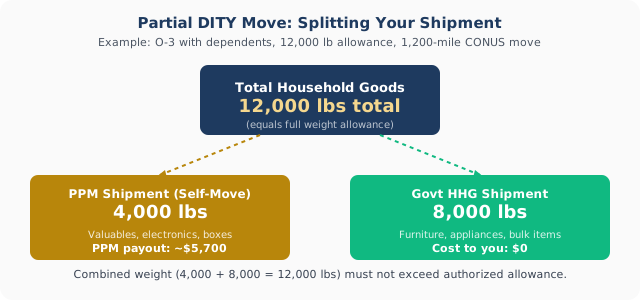
Your combined weight: PPM weight plus HHG weight, cannot exceed your authorized weight allowance. If you're an O-3 with dependents (12,000 lb allowance), you could move 4,000 lbs yourself as a PPM and have the government ship 8,000 lbs as HHG. The 4,000 lbs qualifies for the 95% PPM payout; the 8,000 lbs is a standard government move.
Use our DITY move calculator to estimate what the PPM portion would pay on your specific move. Enter only the weight you plan to move yourself.
Who Benefits Most from a Partial PPM?
Officers with large households. An O-4 or O-5 with 17,000 lbs authorized can't realistically move everything themselves. But moving 4,000–6,000 lbs as a PPM, electronics, valuables, clothing, artwork, high-value items, earns $4,000–$9,000 in PPM income while the contractor handles sofas, refrigerators, and heavy furniture.
Service members with time-sensitive items. Government HHG shipments can take 2–6 weeks in transit. If you need your home office equipment, instruments, firearms, or specialty items at your destination before the HHG arrives, move them personally in a PPM and earn money for it.
Anyone with valuables they don't trust with a mover. Jewelry, firearms, coin collections, and high-value electronics should travel with you, not in a contractor's truck. Moving these items as part of your PPM earns reimbursement for items you'd move yourself regardless.
Members with a light remaining HHG load. If you're already moving some items personally and your remaining HHG weight is under your authorized limit, formalizing the self-moved portion as a PPM is straightforward.
What to Include in Your PPM Portion
The goal is to maximize your PPM payout while keeping the effort manageable. Prioritize items that are:
High reimbursement value per unit effort:
- Boxes of books, clothing, and household goods, dense weight per box, easy to load
- Exercise equipment (weight sets, benches, stationary bikes)
- Tools and power equipment
- Outdoor gear and sporting equipment
- Boxes of kitchen goods
Items you'd move personally regardless:
- Firearms and ammunition (which have special requirements for commercial movers anyway)
- Jewelry and valuable collectibles
- Important documents (original records, passports, financial documents)
- Medications
- Computers, cameras, and high-value electronics
Items NOT worth including in your PPM:
- Heavy furniture (sofas, mattresses, large appliances), these are hard to move without professional equipment and will go on the contractor's truck anyway
- Items in poor condition that you're moving only for the weight
The Financial Math: Partial PPM Example
Let's say you're an E-7 with dependents (13,000 lb authorized allowance) doing a 1,000-mile CONUS move.
Scenario A: Full government HHG move
- Your cost: $0
- Your PPM income: $0
Scenario B: Partial PPM (move 4,000 lbs yourself)
- HHG shipment: 9,000 lbs on government contract (free to you)
- PPM shipment: 4,000 lbs in a rented 16-foot truck
- PPM payout: ~$5,130 (95% of GCC at 40 CWT × ~$135/CWT)
- Moving costs (truck, fuel, supplies): ~$1,800
- Pre-tax profit: ~$3,330
- After 22% tax on profit: ~$2,600 net
Scenario C: Full PPM (move all 13,000 lbs yourself)
- Requires a 26-foot truck plus a trailer, or two trips
- PPM payout: ~$16,673 (95% of GCC at 130 CWT × ~$135/CWT)
- Moving costs (large truck, fuel, labor): ~$3,500–$5,000
- Pre-tax profit: ~$11,673–$13,173
- After tax: ~$9,000–$10,000 net
Scenario C pays significantly more, but it requires moving 13,000 lbs yourself, a serious undertaking for a family household. Scenario B gives you most of the upside with a fraction of the effort.
The right choice depends on your household size, your willingness to manage a significant self-move, and how much vacation time you can take.
How to Split Items Between PPM and HHG
At your TMO counseling session, you'll indicate that you're doing a partial PPM and specify approximately how many pounds you plan to move yourself. The contractor will then schedule pickup for the HHG portion based on your remaining allowance.
Practically, you need to clearly separate what's going with the contractor and what's going in your PPM. Use a different room or area of the house for each. Mark or label boxes that are part of the PPM. When the contractor arrives for the HHG pickup, the PPM items should not be accessible to them, ideally already loaded in your truck or set aside in a clearly designated area.
Weight Tickets on a Partial PPM
The weight ticket requirements are identical to a full PPM:
- Tare weight (empty truck) before loading any PPM items
- Gross weight (full truck) after loading all PPM items
The contractor handles all weight documentation for the HHG portion independently. Your PPM claim is based only on your two weight tickets and the net weight they establish.
The Combined Weight Rule
Your PPM net weight plus the HHG shipment weight (as documented by the contractor) cannot exceed your authorized allowance. DFAS has access to both weight reports and will check compliance.
If you go over your combined authorized weight, you're billed for the excess at the GBL rate on the HHG side. The PPM portion itself doesn't incur overage charges (you can only claim up to your allowance on that side too), but shipping excess weight through the HHG system costs money. Coordinate with your TMO counselor on the split to ensure your combined weights work within your limit.
When the Numbers Don't Work
Not every move justifies a partial PPM. If your PPM portion would be under 2,000 lbs (less than 20 CWT), the reimbursement might not justify the extra paperwork and effort of a separate move. Run the numbers in the PPM move calculator, if the payout on your planned PPM weight is under $1,500, you might be better off letting the government handle everything.
For more details on the full PPM process and documentation requirements, see our PCS move checklist and our weight ticket guide. And if you're comparing a full PPM vs. letting the government move everything, see our PPM vs. government move breakdown.