PPM vs Government Move: Which Pays Off?
Comparing a military PPM move vs a government-contracted HHG shipment. See which option puts more money in your pocket on your next PCS.
The tradeoff: A PPM (Personally Procured Move) pays you 95% of what the government would spend on a contractor. On most moves over 500 miles, you'll profit $2,000–$8,000 after expenses. A government HHG move costs you nothing out of pocket, but you walk away with nothing extra either.
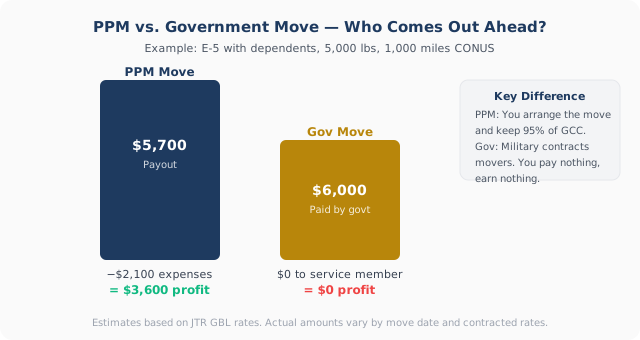
Every military PCS comes with a decision: do the move yourself and get paid for it, or let the government arrange everything? Most service members default to the government move because it's the path of least resistance. That's a mistake if money matters to you.
Here's a clear breakdown of both options so you can decide with actual numbers, not guesswork.
What Is a Government Move (HHG Shipment)?
A government move, officially called a Household Goods (HHG) shipment, means the military contracts a Transportation Service Provider (TSP) to pack, load, transport, and deliver your stuff. You coordinate through the Defense Personal Property System (DPS) and show up on pack day. Simple.
The catch: the military pays the contractor, and you get nothing. The move is free to you in the sense that your wallet doesn't open, but you also don't capture any financial benefit from the move. If the contractor damages items, you file a claim through their liability coverage, which caps at $6 per pound per item unless you opt into additional coverage.
Government moves are the right call when you're moving a very large household, doing an OCONUS move with complicated customs requirements, or when the timing of your PCS makes it impossible to manage a self-move.
What Is a PPM Move?
A PPM (Personally Procured Move) means you arrange your own transportation, rent a truck, hire a container service, load your own vehicle, and the military reimburses you 95% of what it would have paid the contractor. That contractor cost is called the Government Constructed Cost (GCC), set by current GBL (Government Bill of Lading) rates.
The math is straightforward: if the government would have paid $8,000 to move your goods, your PPM payout is $7,600. If your actual moving costs are $2,500, your profit is $5,100. You're taxed on the profit, not the full payout, so you'd owe income tax on $5,100.
Use our DITY move calculator to estimate your specific payout before you decide anything.
Side-by-Side Comparison
| Factor | PPM / DITY | Government HHG |
|---|---|---|
| Who arranges transport | You | Military contractor |
| Out-of-pocket cost | Truck rental + fuel + supplies | $0 |
| Reimbursement | 95% of GCC | N/A |
| Financial upside | $1,000–$10,000+ profit | $0 |
| Liability for damage | You (your insurance or transit coverage) | Contractor (full value protection available) |
| Flexibility | High, you control timing | Lower, contractor availability |
| Weight tickets required | Yes (certified, 2 per move) | No |
| Paperwork | More (DD 2278, weight tickets, receipts) | Less |
When a PPM Beats the Government Move
The PPM wins financially in most of these situations:
Long-distance moves (500+ miles). GBL rates favor the government contractor on long hauls, meaning the GCC is higher on long moves. Higher GCC = higher 95% payout. A 1,500-mile move with 8,000 lbs can pay $7,000–$11,000. If you rent a truck for $2,000 and spend $600 on fuel, you're pocketing $4,400–$8,400 before taxes.
Lighter households. Junior enlisted members with 3,000–5,000 lbs of goods often profit the most relative to the effort required. Moving 4,000 lbs 800 miles in a rented truck costs about $1,500–$2,000. The PPM payout at that weight and distance is roughly $4,000–$5,500. The math is hard to ignore.
Members who own their own truck or have access to a trailer. If your moving vehicle cost is near zero, your profit is almost the full 95% payout minus fuel. Even a 300-mile local move can pay $1,500–$2,500 on a moderate weight shipment.
When the Government Move Wins
Large households moving short distances. If you've got 15,000 lbs and you're moving 150 miles, the GCC is lower because short-haul GBL rates favor short moves. Your 95% payout might not justify renting a 26-foot truck and hiring laborers. Run the numbers on our PPM payout calculator first.
OCONUS moves to complex locations. Shipping household goods to Japan, Germany, or Korea involves container booking, customs clearance, last-mile delivery on a foreign base, and months of lead time. Many service members do a partial PPM (ship some things, let the government move the rest) on OCONUS orders, but a full PPM to most foreign postings isn't realistic. See our OCONUS PPM guide for specifics.
When you're already overwhelmed. If you have a tight report date, no time off, a pregnant spouse, or any significant life complication during your PCS, the government move removes a major logistics burden. The money is real, but so is the stress. Factor that in.
The Hidden Costs Most People Forget
Before you commit to a PPM, account for every expense:
- Truck rental (varies wildly, reserve early, compare rates)
- Fuel (a 26-foot truck gets 8–10 mpg; budget $4.50/gallon for safety)
- Weight tickets ($10–$25 each at CAT scales)
- Packing materials (boxes, tape, bubble wrap, budget $200–$400 for a three-bedroom)
- Hotel stays if the drive is multi-day
- Meals on the road
- Professional movers or day labor for loading/unloading
Add these up before you decide. On a 500-mile move with a heavy household, your costs might be $3,000–$4,500, which could eat most of your profit margin. On a 1,500-mile move, the same costs represent a smaller fraction of a much larger payout.
How to Decide
Plug your weight, distance, and rank into the DITY move calculator. If your estimated profit is under $500, seriously consider whether the extra effort is worth it. If it's $2,000 or more, the PPM almost always makes sense. Between $500 and $2,000, your personal situation, time available, physical capability, family logistics, should tip the decision.
Whatever you choose, elect your option through the DPS portal as early as possible. PPM counseling appointments at the TMO can fill up fast during summer PCS season.
What About a Partial PPM?
You can combine both options: ship most of your goods through the government contractor and move select items yourself in a personal vehicle or small trailer. This is called a partial PPM. Your reimbursement is based only on the weight you move yourself. It's worth considering if you want the best of both worlds, professional movers handle the heavy furniture while you pocket some incentive pay for moving your valuables, electronics, and time-sensitive items. Our partial DITY move guide covers the strategy in detail.
Final Thoughts
The government move is the easier choice. The PPM is often the smarter one. Run the numbers with an honest estimate of your shipment weight and moving expenses, then make the call. The 45-day filing deadline after your report date is firm, there's no extension, so plan your claim documentation from day one.