OCONUS PPM Moves: What to Know Before PCSing Overseas
OCONUS PPM moves pay 35% more than CONUS rates, but the logistics are complex. Here's what you need to know before attempting a self-move to Hawaii, Alaska, or overseas.
Key point: OCONUS PPM moves pay out at 135% of the standard GBL rate, making them potentially very profitable. However, full self-moves to foreign postings are rare. Partial PPMs combined with a government HHG shipment are the most practical strategy for most OCONUS orders.
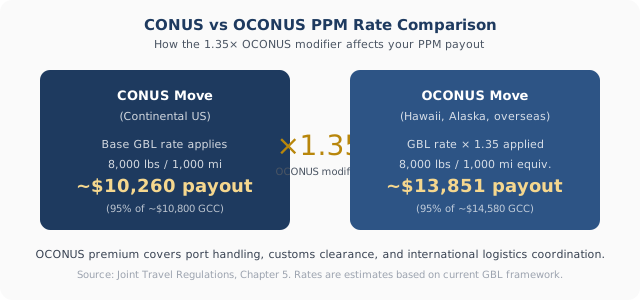
An OCONUS PCS comes with a significantly larger PPM payout potential, but also significantly more complexity. The 1.35× rate modifier exists because overseas logistics genuinely cost the government more: port handling, customs clearance, container shipping, and last-mile delivery at a foreign installation all carry real premiums. You capture that premium when you do a PPM.
The critical question is whether a full OCONUS PPM is even feasible for your specific orders, and in most cases, a partial PPM is the smarter play.
What Counts as OCONUS for PPM Purposes?
OCONUS (Outside Continental United States) for moving purposes includes:
- Hawaii and Alaska: These are PPM-friendly because you can ship a container by sea to a domestic port with relatively straightforward logistics.
- Guam, U.S. Virgin Islands, Puerto Rico: U.S. territories with some additional complexity.
- Germany, Japan, South Korea, Italy, and other NATO/SOFA postings: Foreign country assignments with the most logistical complexity.
- Other overseas commands: Middle East, Africa Command postings, and others, which typically have severely limited PPM options.
The 1.35× modifier applies to all OCONUS moves in our DITY move calculator. For your actual move, the TMO at your losing installation will confirm the applicable rate for your specific origin and destination.
Why OCONUS PPM Payouts Are Higher
The government's contracted moving costs for OCONUS shipments are genuinely more expensive than CONUS moves. A government HHG shipment to Germany involves:
- Packing and crating at origin
- Port delivery and container loading in a U.S. port city (often Baltimore, Charleston, or a West Coast port for Pacific commands)
- Ocean freight across the Atlantic or Pacific
- Customs and port clearance in the destination country
- Delivery to the installation's receiving warehouse
- Last-mile delivery to your quarters on post
All of that costs the government considerably more per pound than a domestic move. The 1.35× GBL modifier compensates for this, meaning your 95% PPM payout on an OCONUS move will be roughly 28% larger than the equivalent CONUS move (0.95 × 1.35 = 1.2825).
For an E-5 with dependents shipping 8,000 lbs, the payout difference is approximately $2,500–$4,000 more on an OCONUS move than a CONUS move of equivalent distance.
The Practical Reality: What You Can Actually Self-Move
Hawaii. Hawaii PPMs are relatively common and generally feasible. You can rent a shipping container through companies like U-Pack or hire a container company, load it yourself, and have it shipped by sea. Container transit from the West Coast to Hawaii takes 2–4 weeks. You'll need to account for the sea freight cost in your expense calculation, but on a heavy shipment the PPM payout usually far exceeds your costs. Budget $3,000–$6,000 for a 20-foot container sea shipment from the West Coast.
Alaska. Alaska PPMs work similarly, container shipping from Seattle to Anchorage or Fairbanks by sea or barge. Transit is 2–5 days from Puget Sound. Container rates are generally $2,500–$5,000 for a standard 20-foot container. On a 10,000+ lb shipment with an O-level weight allowance, the PPM payout can easily cover shipping costs and leave $4,000–$8,000 in profit.
Germany, Japan, South Korea (and other overseas commands). A full PPM where you personally arrange international container shipping is technically possible but practically very difficult. You'd need to coordinate export paperwork, customs declaration, ocean freight booking, import clearance in a foreign country, and last-mile delivery on a foreign military installation. Most service members who attempt this either use a licensed international freight forwarder (which reduces your profit due to their fees) or find the regulatory complexity prohibitive.
The realistic approach for most overseas orders: do a partial PPM for items you can transport personally or ship domestically, while letting the government's HHG program handle the international shipment.
Partial PPM Strategy for OCONUS Orders
A partial PPM means you move some items yourself (claiming PPM reimbursement on that weight) while the government ships the rest. This is the most common approach for OCONUS orders.
Typical partial PPM strategy:
- Ship high-value or time-sensitive items yourself via a domestic container service to a port city, then arrange sea freight. Claim PPM on that weight.
- Have the government contractor handle all heavy furniture, appliances, and bulk goods.
- Vehicle shipment is handled separately through the government, don't count it in your PPM weight.
On a 3,000-lb partial PPM to Hawaii (items shipped via sea container), the PPM payout at a standard NCO rate might be $4,000–$6,000. If your sea freight and container costs are $2,500–$3,500, your profit is $500–$3,500. Modest compared to a full CONUS PPM, but real money for what amounts to moving your valuables yourself.
Use our PPM payout calculator with the OCONUS setting to see your specific numbers.
What Happens to Items Left in CONUS?
If you have items you won't bring OCONUS, a vehicle, furniture, seasonal equipment, you have several options:
Non-Temporary Storage (NTS). The government will store authorized household goods in NTS at no cost for the duration of your OCONUS tour. Items in NTS do not count toward your PPM weight. NTS is coordinated through the TMO.
Privately Arranged Storage. You can store items at a commercial storage facility at your own expense. This doesn't affect your PPM claim.
Sell or give away items. Some service members sell heavy furniture before an OCONUS move and buy new at the destination. This is financially sensible for older furniture but can reduce your PPM weight.
OCONUS Documentation Requirements
OCONUS PPM claims require the same documentation as CONUS, certified weight tickets, receipts for all moving expenses, and your PCS orders, plus any shipping documentation for international freight (bills of lading, container booking confirmations).
The 45-day filing deadline still applies from your report date at the new command. OCONUS filing is typically done at the gaining installation's finance or TMO office.
Key Questions to Ask Your TMO
Before committing to a PPM on OCONUS orders:
- Is a full PPM authorized for my origin-destination pair?
- What is the approved distance for rate calculation purposes?
- Are there any restrictions on what I can ship personally (certain appliances, electronics)?
- What port documentation is required for my destination country?
- Is Non-Temporary Storage available if I leave items in CONUS?
The TMO counseling session is mandatory for OCONUS moves and will answer most of these questions for your specific situation.
For more on avoiding costly mistakes during any move, see our guide on the 7 most common DITY move mistakes. And if you're still deciding whether to do a PPM at all, our PPM vs. government move comparison lays out the full financial picture.