Are PPM Payments Taxable? Military Move Tax Rules
Yes, PPM move payments are partially taxable. Here's exactly how military PPM move income is taxed, what you can deduct, and how to minimize your tax bill.
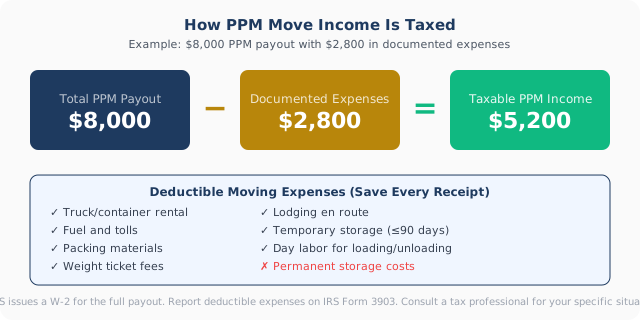
Tax basics: Your PPM payment is taxable income to the extent it exceeds your documented moving expenses. DFAS will issue a W-2 for the full payout. You deduct qualifying expenses on IRS Form 3903. The profit, payout minus expenses, is what you actually owe taxes on.
This is the question most service members ask after seeing how much money a PPM move can generate: is this really income, and do I really have to pay taxes on it?
Yes and yes, but with important nuances that can significantly reduce your tax bill if you understand the rules.
How PPM Move Income Works
The Defense Finance and Accounting Service (DFAS) pays your PPM incentive as compensation for performing a government function (moving your household goods). Because you're being paid for work done, even if that work is just driving a truck, it qualifies as taxable income under IRS rules.
DFAS issues a W-2 form at the end of the tax year showing the full PPM payment as wages. If you received $8,000 for your PPM move, that $8,000 appears as income on your W-2.
Here's where it gets better: you can deduct your actual moving expenses against that income, which reduces the amount you're taxed on.
What Counts as a Deductible Moving Expense
Under IRS Publication 521 and the military moving expense rules, qualifying deductible expenses for a PPM move include:
Transportation costs:
- Truck, trailer, or container rental
- Fuel costs for the moving vehicle
- Tolls paid during the move
- Moving insurance premiums paid on the shipment
Packing and handling:
- Packing materials (boxes, tape, bubble wrap, padding)
- Professional packing services if hired
- Day labor for loading and unloading
Storage:
- Short-term storage directly related to the move (generally up to 30–90 days in storage as your household goods are in transit)
- Storage-in-transit fees
Other allowable costs:
- Weight ticket fees
- Lodging costs during the transit of household goods (not extended stays before/after the move)
- Moving to first port of entry for OCONUS moves
What is NOT deductible:
- Permanent storage costs (beyond the short-term transit window)
- Meals during the move (these may be covered by separate travel pay, not deducted from PPM income)
- Home improvements or repairs at the new location
- Security deposits
- Costs for items you'd have bought anyway (permanent storage furniture, etc.)
The Tax Calculation in Practice
Here's how it works with real numbers:
An E-5 moves 1,000 miles CONUS with 8,000 lbs. Their PPM payout is $10,260.
Moving expenses (documented with receipts):
- Truck rental: $1,400
- Fuel: $520
- Packing materials: $280
- Weight tickets: $40
- One night hotel: $120
- Day laborers (loading): $240
- Total documented expenses: $2,600
Taxable PPM income: $10,260 − $2,600 = $7,660
At a 22% federal marginal tax rate (2026 brackets for a married sergeant), federal income tax on the PPM profit is approximately $1,685.
After tax, the E-5 takes home $10,260 − $2,600 (expenses) − $1,685 (federal tax) = $5,975 in net profit.
Note: state income taxes vary. Some states exempt military pay; others tax PPM income. Check with a military legal assistance attorney or tax professional familiar with your state's rules.
How to Claim Moving Expense Deductions
Active duty military members who move pursuant to a PCS order file their moving expense deduction on IRS Form 3903 (Moving Expenses). This form is straightforward:
- List your total deductible moving expenses
- If expenses exceed your PPM payment, you have a deductible loss (rare but possible on very short moves or very light shipments)
- If your PPM payment exceeds your expenses, you enter the difference as additional income (which should already be on your W-2 from DFAS)
Most tax software (TurboTax Military, H&R Block, TaxSlayer) handles Form 3903 automatically when you indicate you're an active duty military member who moved on PCS orders. Military OneSource also offers free tax preparation through Military Free File.
The SCRA / Military Tax Exemption
The Servicemembers Civil Relief Act (SCRA) doesn't directly exempt PPM income from federal taxes, but it does affect state income tax in important ways. Generally, military members pay state income tax based on their state of legal domicile, not where they're currently stationed. If your domicile is Texas, Florida, Nevada, or another state with no income tax, your PPM income may be exempt from state taxes entirely, even if you're stationed in California or New York at the time of the move.
Keep your Leave and Earnings Statement (LES) showing your state of domicile on file with your PPM documentation. This is the document that establishes your state tax liability.
Documentation Is Everything
The difference between $8,000 in taxable income and $3,000 in taxable income comes down entirely to receipts. Every dollar of documented moving expense is a dollar that doesn't get taxed.
Create a moving expense log from the first day of your PPM and don't stop until you're settled in:
- Date of each expense
- Dollar amount
- Category (fuel, truck rental, packing materials, etc.)
- Receipt reference (photo file name or folder reference)
Store physical receipts in an envelope and photograph each one as you receive it. Email the photos to yourself. Tax documents should be kept for at least three years after filing, though seven years is safer for documentation involving income adjustments.
A Note on Advance Pay
If you received an advance on your PPM through the finance office, that advance is deducted from your final PPM payment, it doesn't change your total taxable income. The W-2 reflects the full PPM payout, and you reconcile the advance separately.
Does Any PPM Income Escape Taxation?
The portion of your PPM payment that equals your documented moving expenses is not taxable, you're being reimbursed for actual costs, not earning income. Only the amount above your expenses is taxable. If your expenses equal or exceed your PPM payout (rare on longer moves), you owe no tax and may have a deductible moving loss.
This is why documenting every expense matters so much. Each $100 in documented expenses saves you $22 in federal taxes at a 22% marginal rate. Over a typical PPM move, thorough documentation can reduce your tax bill by $400–$800 compared to sloppy recordkeeping.
Use our DITY move calculator to estimate your payout, then budget your expected expenses realistically. The difference between the payout and your estimated expenses gives you your expected taxable income, you can plan your tax withholding accordingly rather than getting surprised in April.
For more on the full PPM process, see our PCS move checklist and our guide on avoiding the most expensive DITY move mistakes.
This article provides general information only and should not be construed as tax advice. Consult a qualified tax professional or visit a military legal assistance office for guidance specific to your situation.