7 DITY Move Mistakes That Cost Service Members Money
These seven DITY move mistakes cost military families thousands of dollars every PCS season. Learn what they are and how to avoid every one of them.
Bottom line: The most expensive DITY move mistakes are missing the 45-day claim deadline, getting only one weight ticket instead of two, and failing to save expense receipts. Any one of these can cost you thousands of dollars in reimbursement.
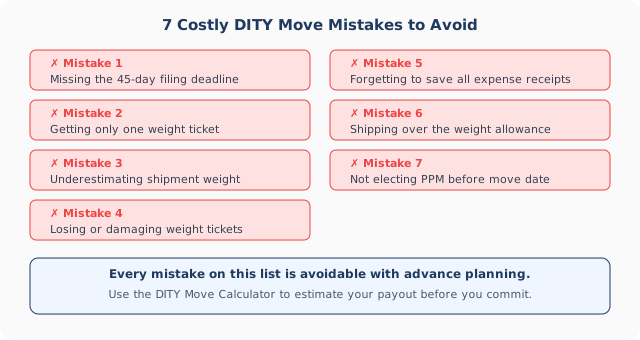
The PPM program pays well, but only if you execute it correctly. Finance offices across every branch see the same avoidable errors every PCS season. This list covers the seven mistakes that collectively cost service members the most money, with specific guidance on how to avoid each one.
Mistake 1: Missing the 45-Day Filing Deadline
You have 45 days from your report date at your new duty station to file your PPM claim. Not from your move date. Not from when your household goods arrive. From when you report in.
DFAS does not grant extensions for missed deadlines. If you file on day 46, you forfeit the entire claim. This is the harshest rule in the program and the one that trips up the most first-time PPM movers.
How to avoid it: File within the first week of reporting. Gather your documentation, DD Form 2278, certified weight tickets, expense receipts, and PCS orders, before you move. Put "PPM claim, file by [date]" on your calendar the day your orders are issued. Don't wait until you're settled in to start the paperwork.
Mistake 2: Getting Only One Weight Ticket
DFAS requires two certified weight tickets: one empty (tare weight) and one full (gross weight). The net weight, gross minus tare, is your official shipment weight and the basis for your entire reimbursement.
If you only have one ticket, your claim will be denied. Period.
The error most people make: they forget to get the tare weight before loading, then try to get it after the truck is returned. By then, the rental company has cleaned the truck and possibly added equipment back, changing the empty weight. That tare ticket is no longer valid for your move.
How to avoid it: Get your tare weight ticket first, before a single box goes in the truck. Drive the empty truck to the nearest CAT scale (most truck stops have them), pay the $10–$15 fee, and keep that ticket somewhere safe, your glove box, your email (photograph it and email it to yourself), or your PCS folder. After loading, get your gross weight ticket. The weight ticket guide on this site walks through the full process step by step.
Mistake 3: Underestimating Your Shipment Weight
Many service members go into a PPM with a rough guess of their household weight, "maybe 5,000 pounds", and don't adjust the estimate based on what they actually end up shipping. If your estimate was based on a smaller apartment but you've accumulated more over the last three years, you might be shipping 8,000 lbs. Our DITY move calculator uses your actual weight from the tickets, not your estimate, so the pre-move estimate is for planning purposes only.
The problem isn't the under-estimate itself, the actual certified tickets determine your payout. The problem is when you pack light because you think the weight won't matter much, leaving heavy items behind that would have earned significant reimbursement.
How to avoid it: Use our PPM weight maximization guide before you decide what to leave behind. Run the number in the calculator with your estimated weight, then run it again with your full authorized allowance. If the difference is $1,000 or more, it may be worth shipping that extra couch.
Mistake 4: Losing or Damaging Weight Tickets
Certified weight tickets are small pieces of thermal paper, the same kind used for gas station receipts. They fade in sunlight, smear when wet, and are easy to lose in a stack of moving paperwork.
How to avoid it: Photograph both weight tickets immediately after getting them. Email the photos to yourself, upload them to cloud storage, and keep the originals in a separate envelope in your vehicle, not in the moving truck. If you do lose the originals, call the scale station where you weighed, some have records on file. DFAS may accept a certified duplicate from the scale operator if obtained promptly.
Mistake 5: Failing to Save Expense Receipts
Your taxable PPM income is the payout amount minus your documented moving expenses. Without receipts, you can't prove your expenses, which means more of your PPM income is taxable.
Deductible PPM expenses include: truck or trailer rental, fuel, tolls, weight ticket fees, packing materials, and travel lodging directly tied to the move. Meals may be deductible at the standard per diem rate. You cannot deduct expenses you can't document.
How to avoid it: Create a physical envelope or a digital folder for every PPM receipt the moment you make the purchase. Fuel receipts, truck rental contract, toll receipts, box purchases, bubble wrap. Even small items add up. A $30 box of packing tape and $80 in bubble wrap means $110 less in taxable income. On a $6,000 profit that saves you roughly $24 in federal taxes at a 22% rate, small individually, but collectively your receipts can reduce your tax bill by $500–$1,500.
Mistake 6: Shipping Over Your Weight Allowance
If your shipment weight exceeds your authorized allowance, you're billed for the excess at the full GBL rate. At $100–$150 per CWT (hundred-weight), going 1,000 lbs over your limit costs $1,000–$1,500 out of pocket.
This most commonly happens when members with lower weight allowances try to move a large household or when they haven't checked their current allowance against what they're actually shipping.
How to avoid it: Know your allowance before loading. For an E-5 with dependents, that's 11,000 lbs. For an E-3 without dependents, it's 5,000 lbs. If you suspect you're close to or over your limit, do a mid-load weigh, drive to a scale when the truck is about 75% full to check your trajectory. Leave behind non-essential items if you're close to the limit.
Mistake 7: Not Formally Electing a PPM Before Moving
You must formally elect a PPM through the Defense Personal Property System (DPS) before you move any household goods. You cannot do the move first and elect PPM afterward.
If you move your household goods without a valid PPM election on file, you don't get paid. The TMO needs your election in the system before your move date so they can issue your authorization to move.
How to avoid it: Get your PPM counseling appointment at the TMO as soon as your orders are issued, ideally 4–6 weeks before your move date. Bring your orders. At the counseling session, you'll complete the DD Form 2278, elect your move type, and get your move authorized. Your TMO counselor is your best friend during this process, they've seen every mistake and will walk you through avoiding them.
Bonus: Not Using a Calculator Before Deciding
Not a mistake in the sense that it violates a rule, but a significant missed opportunity. Many service members decide against doing a PPM based on a vague sense that "it seems like a lot of work" without ever running the actual numbers.
A 15-minute session with the DITY move calculator might reveal you'd profit $5,000+ on your move. Whether that's worth the extra effort is a personal decision, but make it with actual numbers, not a guess.
Quick Reference: What to Do in Order
- Get PCS orders → immediately schedule TMO counseling
- Elect PPM in DPS at counseling appointment
- Estimate weight → run numbers on the calculator
- Reserve truck or container service (4–6 weeks ahead for summer moves)
- Get empty weight ticket before loading
- Load truck, preserving all receipts
- Get full weight ticket after loading
- Drive to new duty station
- Report in, note your report date
- File PPM claim within 45 days of report date