How to Maximize Your DITY Move Weight Allowance
Get every pound you're authorized on your DITY move. Learn how weight allowances work, how to estimate accurately, and tips for maximizing your PPM payout.
The short version: Your PPM payout is based on the actual weight you ship, up to your authorized limit. To maximize it, ship heavy items that are genuinely useful at your next duty station rather than selling or storing them. Use the full allowance if it's financially justified after accounting for moving costs.
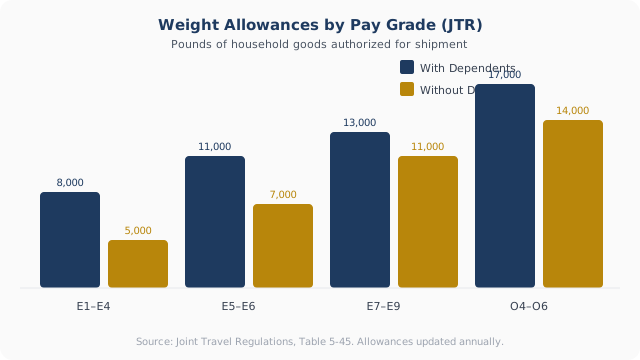
Your DITY move payout is directly tied to how much weight you ship. More weight means a larger Government Constructed Cost (GCC), which means a larger 95% PPM payout. That's not a loophole, it's how the program is designed. The Joint Travel Regulations set your authorized weight allowance by pay grade and dependent status precisely to reflect the typical size of a household at that career stage.
Understanding your allowance, and using it intelligently, is the single biggest lever you have on your PPM income.
How Weight Allowances Work
The Department of Defense sets weight allowances under the Joint Travel Regulations, updated annually. The allowance is the maximum weight the government will reimburse you for moving. If you ship less, you're reimbursed for your actual weight. If you ship more, you pay the overage out of pocket at the GBL rate, which is expensive.
Here's what each pay tier is authorized, rounded to the nearest thousand:
| Pay Grade | Without Dependents | With Dependents |
|---|---|---|
| E-1 to E-4 | 5,000 lbs | 8,000 lbs |
| E-5 to E-6 | 7,000 lbs | 11,000 lbs |
| E-7 to E-9 | 11,000 lbs | 13,000 lbs |
| O-1 to O-3 | 10,000 lbs | 12,000 lbs |
| O-4 to O-6 | 14,000 lbs | 17,000 lbs |
| O-7+ | 18,000 lbs | 18,000 lbs |
The "with dependents" column applies if you have any family members on your military ID card, spouse, children, or dependents. This is true even if they're not physically moving with you.
Use our DITY move calculator to see how your allowance directly affects your payout at different distances.
Why Most People Ship Less Than Their Allowance
Most service members don't use their full weight allowance. There are three main reasons:
They don't own enough stuff yet. Junior enlisted members, especially single E-3s on their first PCS, might realistically have 2,500–4,000 lbs of household goods. There's nothing to do about this except accept it, you can't ship sand to inflate your weight.
They're moving into furnished housing. If your next duty station offers furnished quarters on post or you're moving into a one-bedroom with minimal furniture, you may have packed and sold larger items before the move. This legitimately reduces your shippable weight.
They're shipping some items ahead through the government. If you're doing a partial PPM, only the weight you personally arrange gets counted toward your reimbursement. Items in the government HHG shipment do not.
What You Can Do to Maximize Your Authorized Weight
The goal isn't to artificially inflate your weight, it's to make sure you're shipping everything you're entitled to and that genuinely belongs in your next home.
Audit what you'd otherwise leave behind. Many service members sell, donate, or store heavy items before a PCS because they "don't want to deal with it." Before you do that, run the numbers. A $200 used couch weighs 60–80 lbs and could add $80–$160 to your PPM payout on a long move. Not enough on its own, but multiply that across a dozen items and you're talking $1,000–$2,000 in payout you'd otherwise forfeit.
Include exercise equipment. A set of free weights, a squat rack, or a rowing machine weighs a lot and is worth shipping rather than buying again at your next duty station. Gym equipment can add 200–500 lbs with minimal additional moving effort.
Ship tools and workshop equipment. Power tools, hand tools, lawn equipment, and garage gear are heavy and expensive to replace. If you own them, ship them. An average tool chest with contents weighs 150–300 lbs.
Include outdoor gear. Kayaks, paddleboards, bicycles, camping equipment, and hunting gear are all shippable household goods. A pair of kayaks can add 100–200 lbs. A full camping setup can add 50–100 lbs.
Consider shipping your vehicle-related gear. Roof racks, bed liners, trailer hitches, and spare wheels are shippable if they're not on the vehicle at weigh time.
Don't leave seasonal items behind. Holiday decorations, seasonal clothing, and outdoor furniture often get left behind or stored. If they fit under your allowance, ship them.
The Weight Ticket Process
Your PPM reimbursement is based entirely on certified weight tickets, not estimates, not your memory of what was on the truck. You need two tickets:
- Tare weight (empty): Weigh the empty rental truck before loading anything. Do this at a certified scale (CAT scale at a truck stop, recycling center, or installation scale). You need the vehicle registration or rental agreement with you.
- Gross weight (full): Weigh the fully loaded truck after loading all household goods but before driving to your new location. The gross weight minus the tare weight is your net shipment weight.
DFAS requires both original tickets. Get them on the same vehicle with the same identification. Do not use an estimate or a receipt, they will not be accepted.
A detailed walk-through of the weight ticket process is in our weight ticket guide.
Common Weight Calculation Mistakes
Weighing the truck before unloading. Your full weight ticket is valid at any point during the move, but some service members mistakenly try to get their tare weight after returning the truck, after the rental company has already added equipment back. By then the tare weight is different. Get both tickets on the same day with the same truck configuration.
Not accounting for packing material weight. Boxes, packing paper, bubble wrap, and furniture pads add up. A fully packed three-bedroom move might have 150–250 lbs of packing materials. Those count toward your weight, keep them in the truck.
Forgetting to include items being moved by a trailer or second vehicle. If you ship goods in both a rented truck and a personal trailer, you need weight tickets for both. Many service members forget the trailer and lose reimbursement on everything in it.
Shipping above your allowance. If your gross weight minus tare weight exceeds your authorized allowance, you pay the full GBL rate on the excess. At $100–$150 per CWT, 500 lbs over your limit costs $500–$750. Weigh early in the loading process to check where you stand, then decide whether to leave anything behind.
Using Our Calculator to Plan Your Move
Before you start loading a truck, plug your estimated weight and move distance into the PPM reimbursement calculator. Run three scenarios: your estimated weight, 10% below, and your full authorized allowance. The difference in payout between 6,000 lbs and 8,000 lbs on a 1,000-mile move is roughly $2,000. That $2,000 spread might justify renting a larger truck or making a second trip.
If you're doing a partial PPM and want to understand how splitting your shipment affects your total payout, see our partial DITY move guide for the math.
A Word on Honesty
You cannot legally add weight to your shipment that doesn't represent actual household goods. You can't load sand, rock, or scrap metal to inflate your weight. DFAS and the TMO have seen every trick. The weight tickets document what's actually in the truck, and you sign a legal attestation that the shipment represents your household goods. The penalties for fraudulent claims include repayment of the overpayment plus potential UCMJ action. Ship legitimately, the program pays well enough without games.